1 Convolution
1.1 Linear Time-Invariant (LTI) Systems
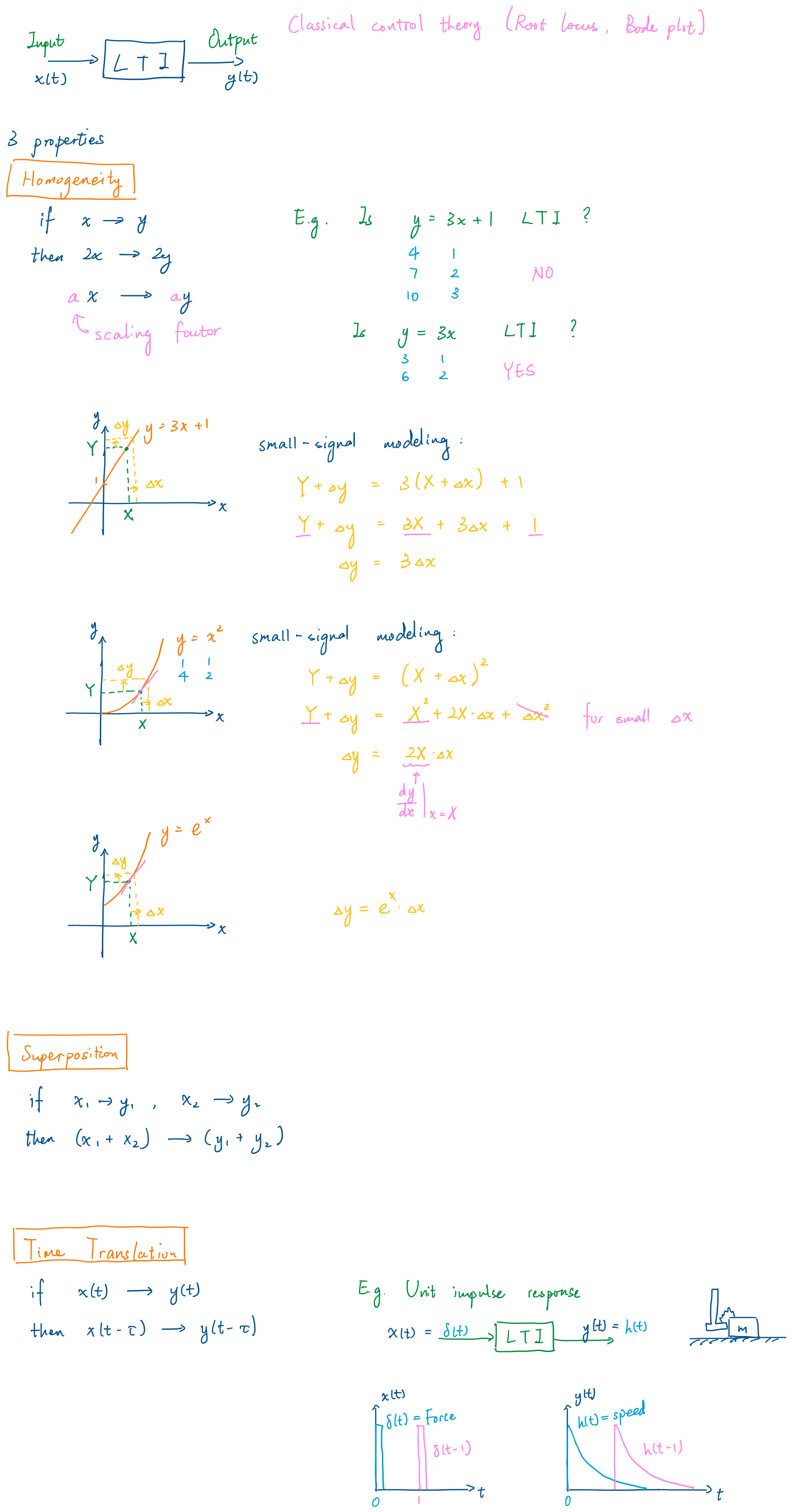
1.2 Convolution
\[\begin{equation} h(t) * x(t) = \int_{-\infty}^{\infty} x(\tau)h(t-\tau) \,d\tau \end{equation}\]
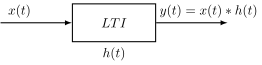
where \(h(t)\) is the unit impulse response: \(\begin{cases}\text{when } x(t) = \delta(t)\\\text{then } y(t) = h(t)\end{cases}\)
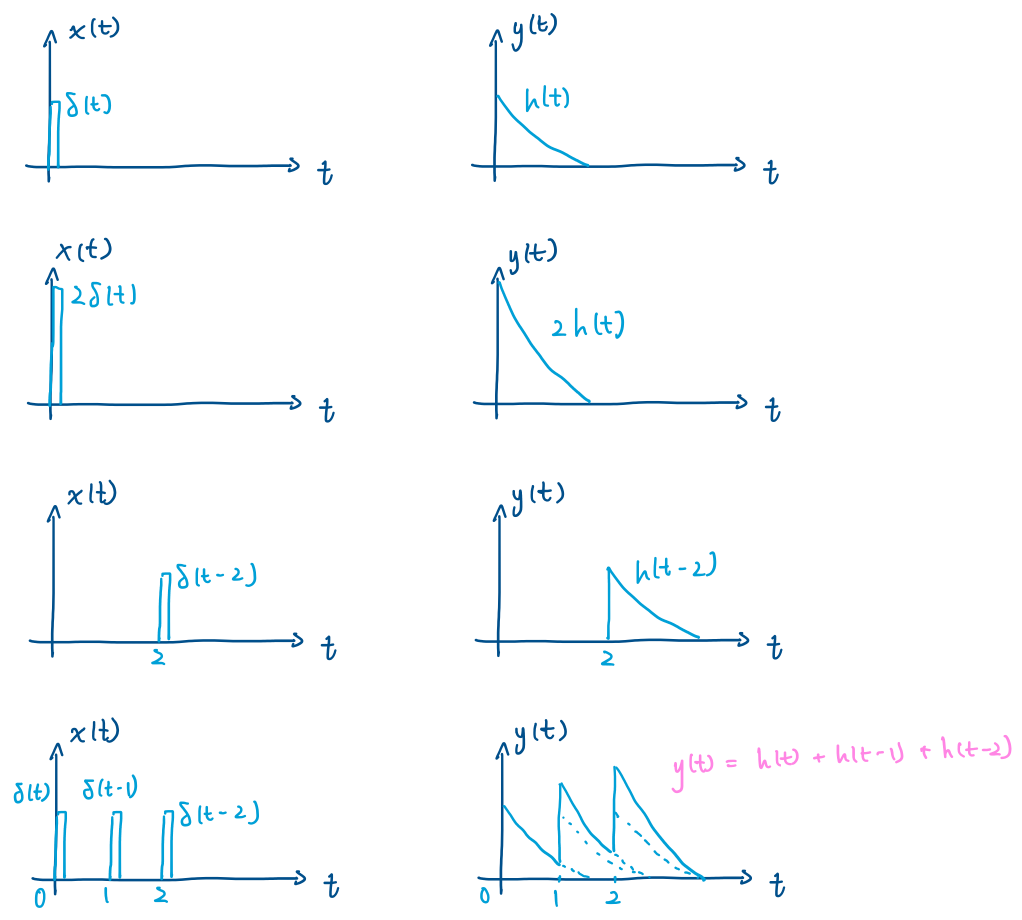
\[ \int_{-\infty}^{\infty} h(t) \,dt = 1. \qquad y(t) = \delta(0) \cdot h(t) + \delta(1) \cdot h(t-1) + \delta(2) \cdot h(t-2) .\]
For LTI system, \(y(t)\) is the sum of the scaled unit impulse response of \(x(t)\) at each time instant \(\tau\). \[y(t) = \int_{-\infty}^{\infty} x(\tau)h(t-\tau) \,d\tau\] where \(x(\tau)\) is the scaling factor at \(t=\tau\), and \(h(t-\tau)\) is the unit impulse response at \(t=\tau\).
For a continuous $x(t) with \(h(t) = \dfrac{1}{2}t\), (\(0 \le t \le 2\)), what is \(y(t)\)? 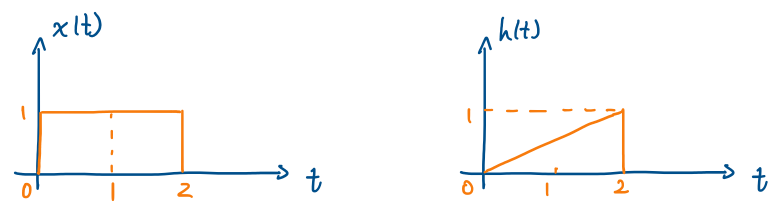
Time domain convolution compuation is expensive, and it can be simplified by using Fourier transform to transfer convolution in time domain to multiplication in frequency domain.
\[\text{Time domain} \underset{\text{F. T.}}{\overset{\text{Fourier Transform}}{\longrightarrow}} \text{Frequency domain}\]
\[\text{F. T.:}\quad Y(\omega) = \int_{-\infty}^{\infty} y(t) e^{-j\omega t} \,dt\]
Proof: \(\mathcal{F}[f(t) * g(t)] = F(\omega) \cdot G(\omega)\).
\[\begin{align*} \mathcal{F}[f(t) * g(t)] &= \int_{-\infty}^{\infty} \left(\int_{-\infty}^{\infty} f(\tau)g(t-\tau) \,d\tau\right) \cdot e^{-j\omega t} \,dt \\ &= \int_{-\infty}^{\infty} \int_{-\infty}^{\infty} f(\tau) \cdot g(t-\tau) \cdot e^{-j\omega t} \,d\tau dt \\ &= \int_{-\infty}^{\infty} f(\tau) \left( \int_{-\infty}^{\infty} g(t-\tau) e^{-j\omega t} \,dt \right) d\tau \\ &= \int_{-\infty}^{\infty} f(\tau) \cdot e^{-j\omega \tau} \cdot G(\omega) \,d\tau \tag{see note below} \\ &= G(\omega) \cdot \int_{-\infty}^{\infty} f(\tau) e^{-j\omega \tau} \,d\tau \\ &= F(\omega) \cdot G(\omega) \end{align*}\]
Note that: \[\begin{align*} \mathcal{F}[g(t)] &= G(\omega) \\ \mathcal{F}[g(t-\tau)] &= \int_{-\infty}^{\infty} g(t-\tau) e^{-j\omega t} \,dt \\ &= \int_{-\infty}^{\infty} g(t-\tau) e^{-j\omega (t-\tau)} \,dt \cdot e^{-j\omega \tau} \\ &= \int_{-\infty}^{\infty} g(u) e^{-j\omega u} \,du \cdot e^{-j\omega \tau} \tag{let $u = t-\tau$} \\ &= e^{-j\omega \tau} \cdot G(\omega) \end{align*}\]